

An IDD Guide for North Carolina
The Arc of North Carolina has created this guide to offer you helpful information and resources in the IDD sector of North Carolina. You will find links to the information mentioned in each section at the end of this guide.
Table of Contents:
Waiver Options in NC
Managed Care Organizations
Tailored Care Management
Securing the Foundation: Healthcare, Food and Nutrition, and Financial Planning
From Birth to Early Childhood
Navigating the School Years: Being an Effective Advocate
Transition to Adulthood: Higher Education and Employment
Building an Independent Life: Housing and Daily Activities
Guardianship, Alternatives to Guardianship, and Supported Decision-Making

Waiver Options in North Carolina
There are currently two waiver options in the state:
-
-
- Innovations Waiver
-
- State’s primary funding source for comprehensive, community-based support
- No restrictions on age, income, or insurance
- The waiting list is very long, so it is essential to get your loved one’s name on it as soon as possible
- Supports such as assistive technology, car and home modifications, caregiver support, residential programs, and crisis services
- Call the Managed Care Organization (MCO) for your county to get on the list
-
-
- 1915(i) Waiver
-
- Opportunity to get services while waiting on an Innovations Waiver slot
- Services for those with IDD, Mental Health, Substance Use or Traumatic Brain Injury (TBI)
- Less robust support than the Innovations Waiver, but does include help with daily life and living skills, job coaching, and respite
- Medicaid is required, and you must be enrolled in a Tailored Plan, NC Medicaid Direct, or the EBCI Tribal Option
- Tailored Care Managers (TCMs) are required to apply for this waiver on behalf of the individual
Managed Care Organizations
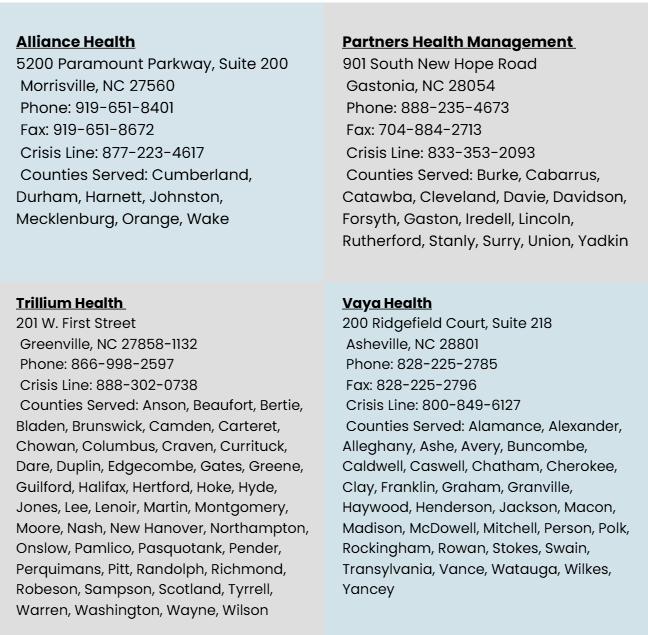
The Managed Care Organization (MCO) is the front door for all publicly funded IDD, mental health, and substance use services in North Carolina. They operate a lot like an insurance company and authorize and pay for these services. There are four in the state that cover all 100 counties. They manage Tailored Plans and services (concerns/complaints can be addressed at MCO), the Innovations Waiver Registry of Unmet Needs (the RUN or the waiting list) and they are who you are to call to opt into Tailored Care Management.
Tailored Care Management
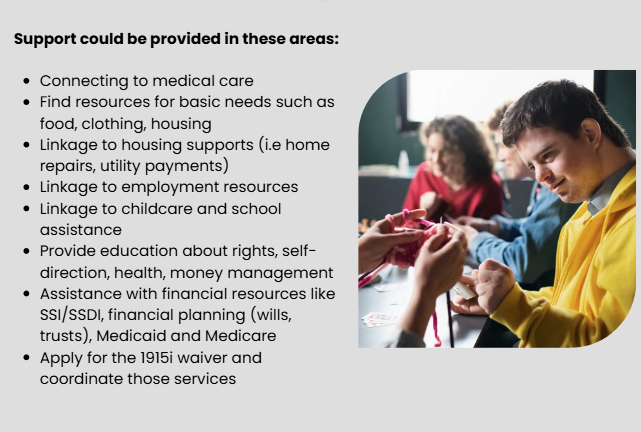
The goal of Tailored Care Management (TCM) is to support the person as a whole and make sure that everything is working together to benefit the individual the most.
TCM is a service that is a choice through Medicaid, specifically the tailored plan. Individuals are not automatically enrolled into this service, so they will need to call the MCO and opt into it. You can also choose what agency you would like to provide TCM. The MCO can provide a list of agencies, or they can be auto assigned to an agency. All of the MCOs provide this service, as do a number of community organizations. If you ever become unhappy with your TCM provider or would like a change, that is easy to do.

Securing the Foundation: Healthcare and Financial Planning
Medicaid Coverage
Medicaid is the key to receiving services in the state. Even if you’ve been denied before, it’s worth reapplying, as income rules have changed. If your loved one has a diagnosis of Intellectual/Developmental Disability, Mental Health, or Substance Use Disorder, they qualify for the Tailored Plan of Medicaid. This is what unlocks Tailored Care Management and the 1915i waiver.
Community Alternatives Program for Children or Disabled Adults (CAP/C)
Supplemental Security Income (Children with significant disabilities or who are medically fragile may qualify for CAP/C. Children who are at risk of being in an institution can be eligible for this program and receive assistance with nurse care, assistive technology, in-home supports, care management, and more. CAP/C is for children through age 20 and a referral needs to be made by calling ACENTRA Health or a CAP/C case management entity.
Community Alternatives Program for Disabled Adults (CAP/DA)
Very similar to CAP/C, CAP/DA is for adults 18 and over who are at risk of institutionalization or looking to move out of a facility. The person needs to have severe and chronic physical disabilities that typically need care found in a facility. Assistance looks the same as CAP/C. A referral can be made by calling NCLIFTSS or with a CAP/DA case management entity.
Food and Nutrition Services
The food and nutrition services here in NC is also known as food stamps or the Supplemental Nutrition Assistance Program (SNAP). This service is for eligible individuals who need assistance purchasing food. Applications can be done online through the ePass portal online where you apply for Medicaid, or in person at the local DSS office. While individuals under 18 typically need information for parents and others in the home, that can change if a person needs a specialized diet that is different from the rest of the persons in the home, or if they are an adult living independently.
Social Security Income
Supplemental Security Income (SSI) is a federal payment program that provides a monthly check and automatically qualifies your loved one for Medicaid. SSI can help children or adults with little or no income, have a disability, or over the age of 65. While eligibility for a child is based on family income, everything changes at age 18, when only your child’s income and assets are considered.
Protecting Assets
An individual on Medicaid can’t have more than $2,000 in assets. This is where strategic planning comes in.
- ABLE Accounts: These are tax-advantaged savings accounts for disability-related expenses. The money in an ABLE account does not count against the asset limit, allowing your family to save for the future.
- Special Needs Trusts: This is the legal tool used to hold an inheritance or other significant assets for your loved one without disrupting their essential benefits.

From Birth to Early Childhood
For Infants and Toddlers (Birth to Age 3)
Early intervention is impactful! If you have concerns about your young child’s development, reach out to the North Carolina Infant-Toddler program. This program connects you with a local Children’s Developmental Services Agency (CDSA), which provides free evaluations, crucial therapies like speech, physical, and occupational therapy, and other valuable resources.
Local Partnership for Children (Smart Start) agencies are also a valuable resource for families starting from a child’s birth. They can help with childcare referrals, programs for young children, parental education, local resources, and other support depending on the partnership in the county you live in.
For Children Ages 3 and Up
Once your child turns three, a critical point of contact is the Managed Care Organization for the county that you reside in.
When you call the MCO, you have two critical priorities:
- Get on the Innovations Waiver waiting list (called the RUN).
- Request a Tailored Care Manager. If your loved one has active Medicaid, ask for a Care Manager. This person is your dedicated navigator, your guide for finding providers, troubleshooting issues with the school system, and connecting you to community support and resources.
NC Pre-K programs offer free preschool for 4-year-olds who meet eligibility requirements. There are Exceptional Children’s (EC) programs as well through NC Pre-K, meaning that EC services can start at the age of three. Check in with your local Partnership for Children to learn more information.

Navigating the School Years: Being an Effective Advocate
Your child is entitled to a free, appropriate public education (FAPE) in the least restrictive environment (LRE). If you need help advocating, parent resource centers like the Exceptional Children’s Assistance Center (ECAC) are available to help. The Arc of NC can also help with advocacy in IEP meetings if available.
IEP vs. 504 Plan: Your child will likely have either an Individualized Education Program (IEP) for specialized instruction or a 504 Plan for accommodations that provide access to the curriculum. With parental consent, evaluations are done to determine the eligibility of the student and then a meeting is held to review and then determine services.
Transition Planning: The school must begin planning for life after graduation by the time your child turns 14. This transition plan is part of the IEP and should connect you with adult service agencies like Employment and Independence for People with Disabilities (EIPD). This agency was formerly known as Vocational Rehabilitation (VR).

The Transition to Adulthood: Higher Education and Employment
Finishing high school opens a new chapter of possibilities. Several programs are designed to help young adults either continue their education or start working in the community. Work Together NC is a statewide initiative to help with finding and connecting to resources for transitioning to adulthood.
Post-Secondary Programs
Community colleges and state universities have programs that offer vocational skills training, resulting in either a certification or even diploma options. Think College has a college find tool that will list each college in the state that offers programs for those with intellectual disabilities and what they offer.
Employment and Independence for People with Disabilities (EIPD)
A statewide agency that provides free employment services, from career exploration and counseling to on-the-job training and support. They often begin working with students at age 14 through Pre-Employment Transition Services (Pre-ETS) to prepare them for the workforce.

Building an Independent Life: Housing and Daily Activities
The goal for many is a fulfilling life in the community. This involves finding the right home and engaging in meaningful daily activities.
Housing Options
Your Care Manager can help you explore options, which may include Alternative Family Living (AFL) homes, group homes for 24/7 support, or independent living in an apartment. For affordable rent, reach out to local Public Housing Authorities (PHAs) for Section 8 Housing Choice Vouchers and local Income-Restricted Housing. Your Managed Care Organization can assist with housing as well and may have programs to assist. The Arc of NC owns and operates many units across the state ,ranging from apartments to group homes as well. An application process is necessary with The Arc of NC’s housing. Please note: We are the owner of the property and are responsible for managing the property; any service that happens inside the dwelling would be from a different provider.
Community Engagement
Many individuals enjoy attending day programs in their community. Care Managers can assist with this, or a search can show local day programs in your area. Private pay may be an option, but many require waiver services, mostly the Innovations Waiver. You can also ask about waiver services like Community Networking, which provides staff support to help your loved one volunteer, join clubs, or take classes—whatever their interests may be. Community Living and Support services (1915i) can help individuals use their community by having staff accompany them. Employment and Independence for People with Disabilities offer independent living services as well.
Guardianship and Alternatives to Guardianship
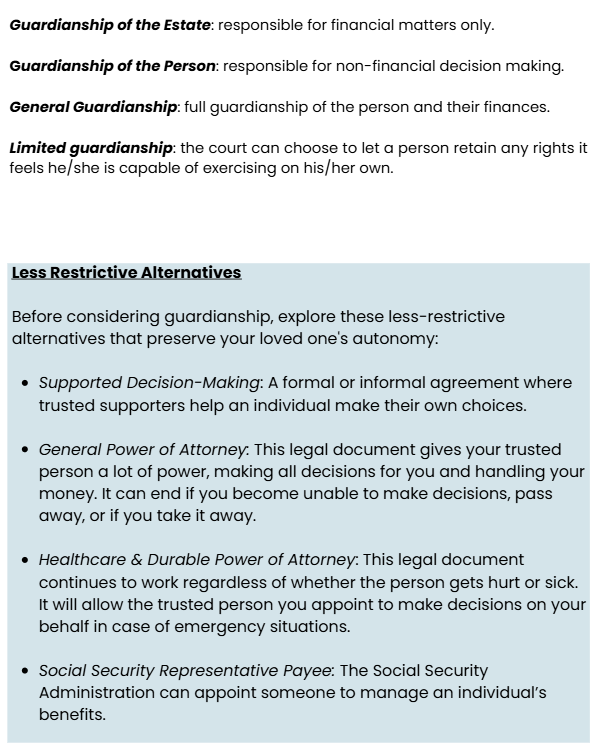
When someone turns 18, regardless of their cognitive functioning, they are an adult in the eyes of the law unless and until the Clerk of Court determines that they need a legal guardian. This is a case-by-case situation and is a decision that should not be made lightly or without investigating all the options. You do NOT need a lawyer in order to apply for guardianship of your loved one, but that is your option.
Guardianship is a court-ordered legal relationship in which a person is appointed to make decisions for someone who needs assistance in managing their own affairs. The individual does retain some rights under guardianship. The main role is to assist the individuals in managing their personal welfare, health, education, and/or financial affairs, which includes decisions about living situations, medical care, and financial management.
If you already have guardianship in another state and you’ve moved to NC, you must file the requisite forms with the Clerk of Superior Court in your county of NC, and there’s a process for that.
Guardianship is something that does not have to be permanent, either. People who have legal guardians can have their competency restored to either limited guardianship or no longer need a legal guardian at all.
Filing for legal guardianship requires an in-person trip to the Clerk of Court’s office for your county. After filing the correct paperwork, the person is assigned a Guardian Ad Litem and that person, usually a local attorney, will attend the hearing with their recommendation. This is a process to make sure that the individual’s rights are protected. If you are considering filing for legal guardianship of your child, you will want to do this about six months before they turn 18.
Resource Index
Waiver Options
- Innovations Waiver: https://medicaid.ncdhhs.gov/beneficiaries/nc-innovations-waiver
- 1915i Waiver: https://medicaid.ncdhhs.gov/beneficiaries/1915i
Managed Care Organizations
MCO Directory: https://www.ncdhhs.gov/providers/lme-mco-directory
Tailored Care Management
- https://medicaid.ncdhhs.gov/beneficiaries/tailored-care-management
- https://www.arcnc.org/what-is-care-management
- https://www.arcnc.org/wp-content/uploads/2023/11/What-Can-TCM-Do-For-Me.pdf
- https://www.arcnc.org/wp-content/uploads/2023/11/What-Can-TCM-Do-For-Me-SPANISH.pdf
- List of Tailored Care Management Agencies: https://medicaid.ncdhhs.gov/certified-tailored-care-management-providers/download?attachment
The First Steps: From Birth to Early Childhood
- ICDSA Directory: https://www.ncdhhs.gov/divisions/child-and-family-well-being/north-carolina-infant-toddler-program-nc-itp/nc-itp-childrens-developmental-services-agency-directory
- Head Start: https://www.dpi.nc.gov/districts-schools/classroom-resources/office-early-learning/preschool/head-start
- NC Pre-K: https://ncchildcare.ncdhhs.gov/Home/DCDEE-Sections/North-Carolina-Pre-Kindergarten-NC-Pre-K
Securing the Foundation: Healthcare and Financial Planning
- ePASS Portal (Food Stamps & Medicaid): https://epass.nc.gov/login
- Medicaid Application (NC DHHS): https://medicaid.ncdhhs.gov/apply
- CAP/C: https://medicaid.ncdhhs.gov/capc
- CAP/DA: https://medicaid.ncdhhs.gov/providers/programs-and-services/long-term-care/community-alternatives-program-disabled-adults-capda
- NCLIFTSS-CAP/C: https://ncliftss.acentra.com/cap-c/
- NCLIFTSS- CAP/DA: https://ncliftss.acentra.com/cap-da/
- ACENTRA: https://ncliftss.acentra.com/
- Social Security Administration: 1-800-772-1213 https://www.ssa.gov/apply/ssihttps://www.ssa.gov/disability/disability_starter_kits.htm
- Special Needs Trusts: https://adanc.org/wp-content/uploads/2018/08/Special-Needs-Trusts.pdf
- NC ABLE Program: https://ncable.nc.gov/ https://cdn.unite529.com/jcdn/files/UABLE/pdfs/nc-programdescription.pdf5
Navigating the School Years: Being an Effective Advocate
Exceptional Children’s Assistance Center: https://www.ecac-parentcenter.org/
Transition to Adulthood: Higher Education and Employment
- Work Together NC: https://worktogethernc.com/
- Think College Search: https://thinkcollege.net/college-search
- Employment and Independence for People with Disabilities: https://www.ncdhhs.gov/eipd
Building an Independent Life: Housing and Daily Activities
- Targeted Unit Housing Program (NC): https://www.ncdhhs.gov/divisions/aging/permanent-supportive-housing
- Public Housing Authority: https://www.hud.gov/states/north-carolina
- The Arc of NC Housing: https://www.arcnc.org/programs-and-services/housing
- Independent Living Services through EIPD: https://www.ncdhhs.gov/divisions/employment-and-independence-people-disabilities/independent-living-people-disabilitieso
Guardianship, Supported Decision-Making, and Alternatives
- Guardianship Information for NC from NC Courts
- Common Forms Used in Guardianship Proceedings
- Initial Guardianship Filing– Form AOC-SP-200
- Restoration of Rights Filing– Form AOC-SP-215
- Motion to Modify Guardianship– Form AOC-E-415
- Common Forms Used in Guardianship Proceedings
- Responsibilities of Guardians in North Carolina
- Supported Decision-Making Information
- Rethinking Guardianship (Least Restrictive Alternatives)
- NC Guardianship Association
- Protection and Advocacy Agency for NC